Every summer, storms roll across the Lake Houston area, and every summer the same thing happens the morning after. Homeowners in Atascocita, Humble, and Kingwood walk outside, look up, see a roof that looks like a roof, and go about their day.
Most of the time they are right. Sometimes they are wrong in a way that costs them the deductible, the claim, or the policy itself.
Extreme damage is obvious
When a straight-line wind gets under a section of shingles and peels it back to the decking, nobody needs a drone to find it. There is plywood showing from the street and shingles in the neighbor's pool. You call your agent, the adjuster comes out, the claim gets paid. That is how wind damage works in most people's minds, and it is why most people never think about the other kind.
Most wind damage doesn't look like that
Wind damage to an asphalt roof usually starts small. A gust catches the bottom edge of a shingle tab and lifts it. The sealant strip that holds it to the course below let's go. The tab creases at the nail line, flexes a few hundred times over the next few storms, and eventually tears loose and blows off.
What is left is a gap about five inches tall and a foot or two wide, showing the felt underlayment or the top of the shingle underneath. From a hundred feet up, it is a small dark rectangle. From the ground, it is nothing at all.
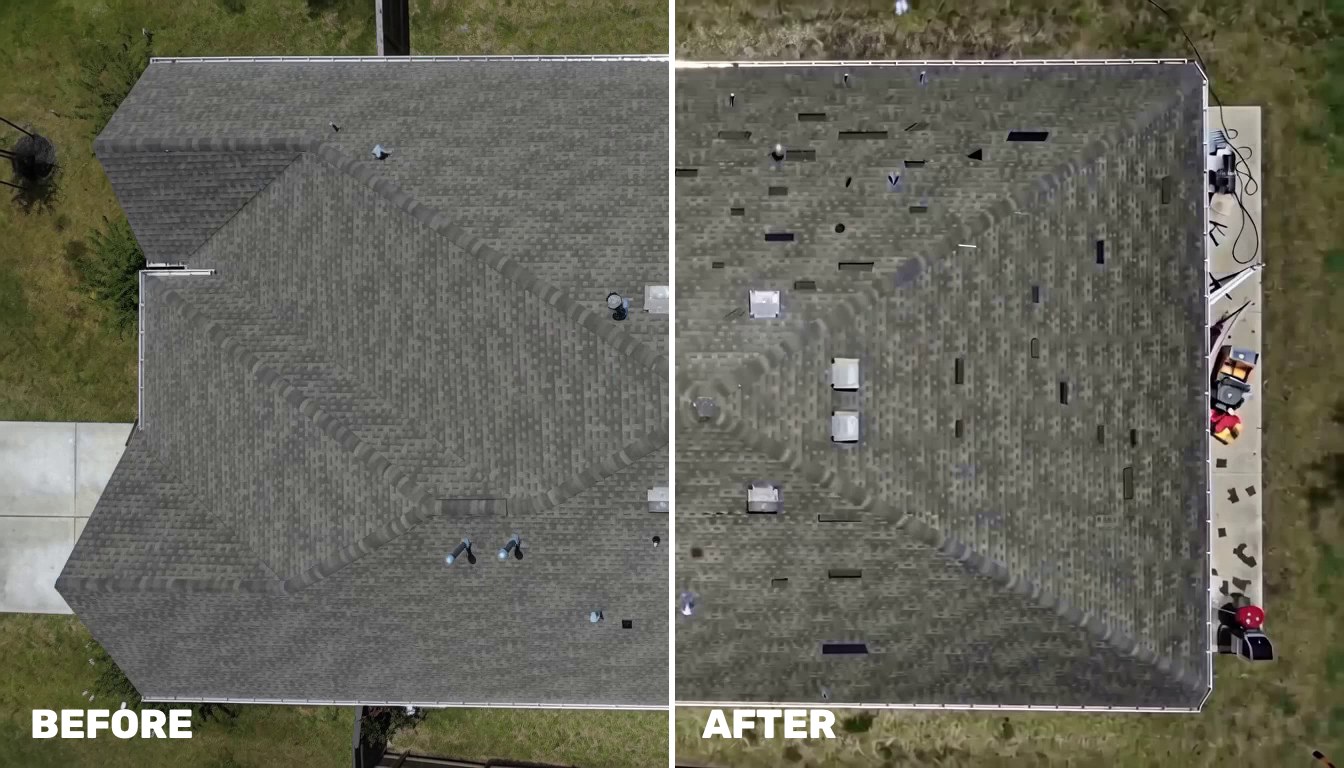 Same roof, same angle. Left is before the storm. Right is after. From the driveway both look identical.
Three tabs, thirty feet up, on the back slope
Here is the roof from the video after a moderate storm. Not the dramatic one. The ordinary one.
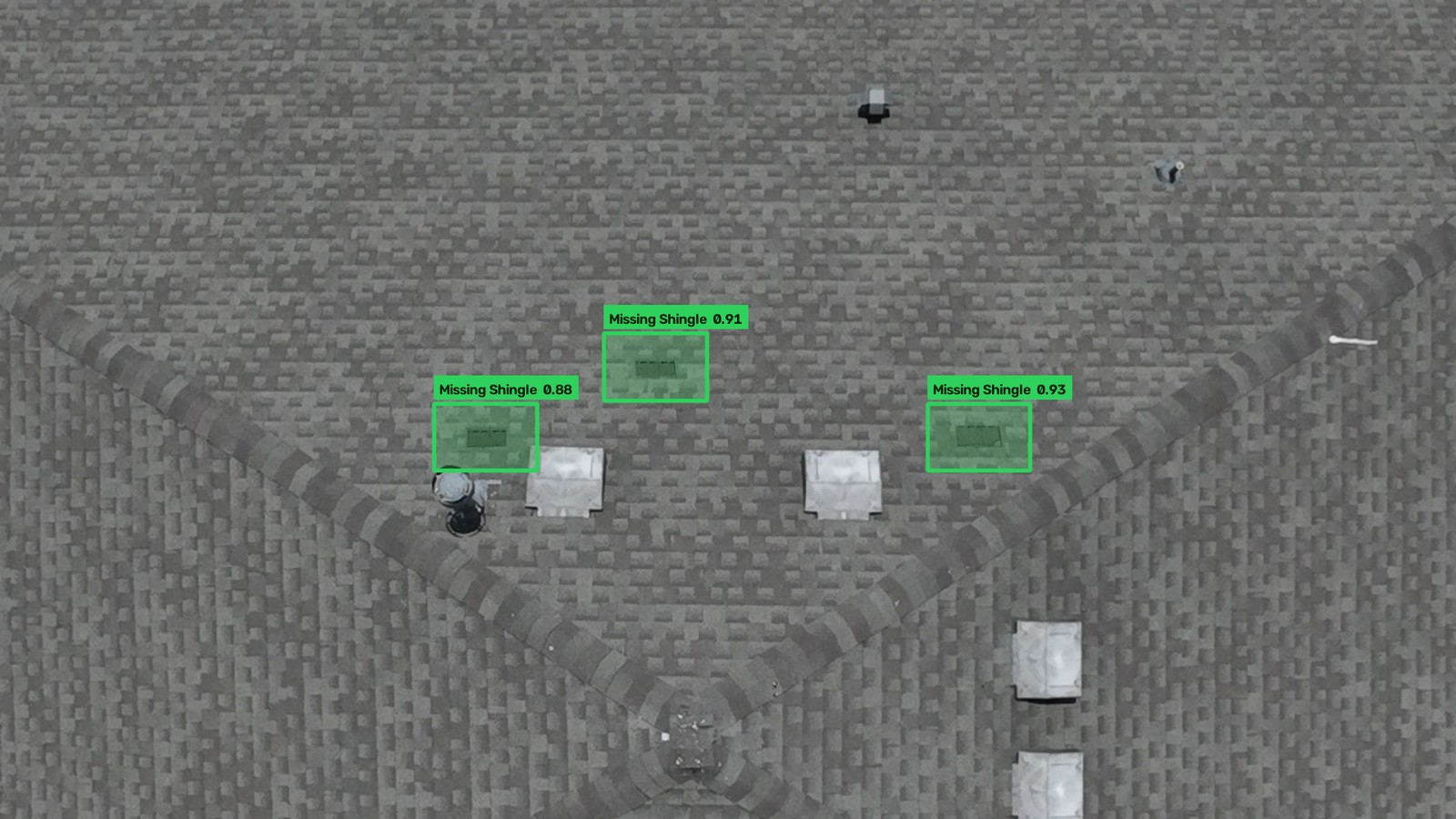 Three missing tabs near the ridge on the back slope, flagged by RoofInspect AI.
Three missing tabs, all on the slope that faces away from the street. The gutters are clean. The shingles are gray. Nothing is out of place from any angle a person can reach without a ladder.
Nobody sees them. The homeowner does not, because there is no reason to look. The neighbor does not. A contractor driving by does not. The first thing that finds those three gaps is the first heavy rain that sits on the felt long enough to soak through.
By then the claim is not a wind claim anymore. It is a water claim, with a decking repair, an interior repair, and a question from the adjuster about how long the roof had been open. If the answer is "a while," the conversation gets harder.
What the drone found
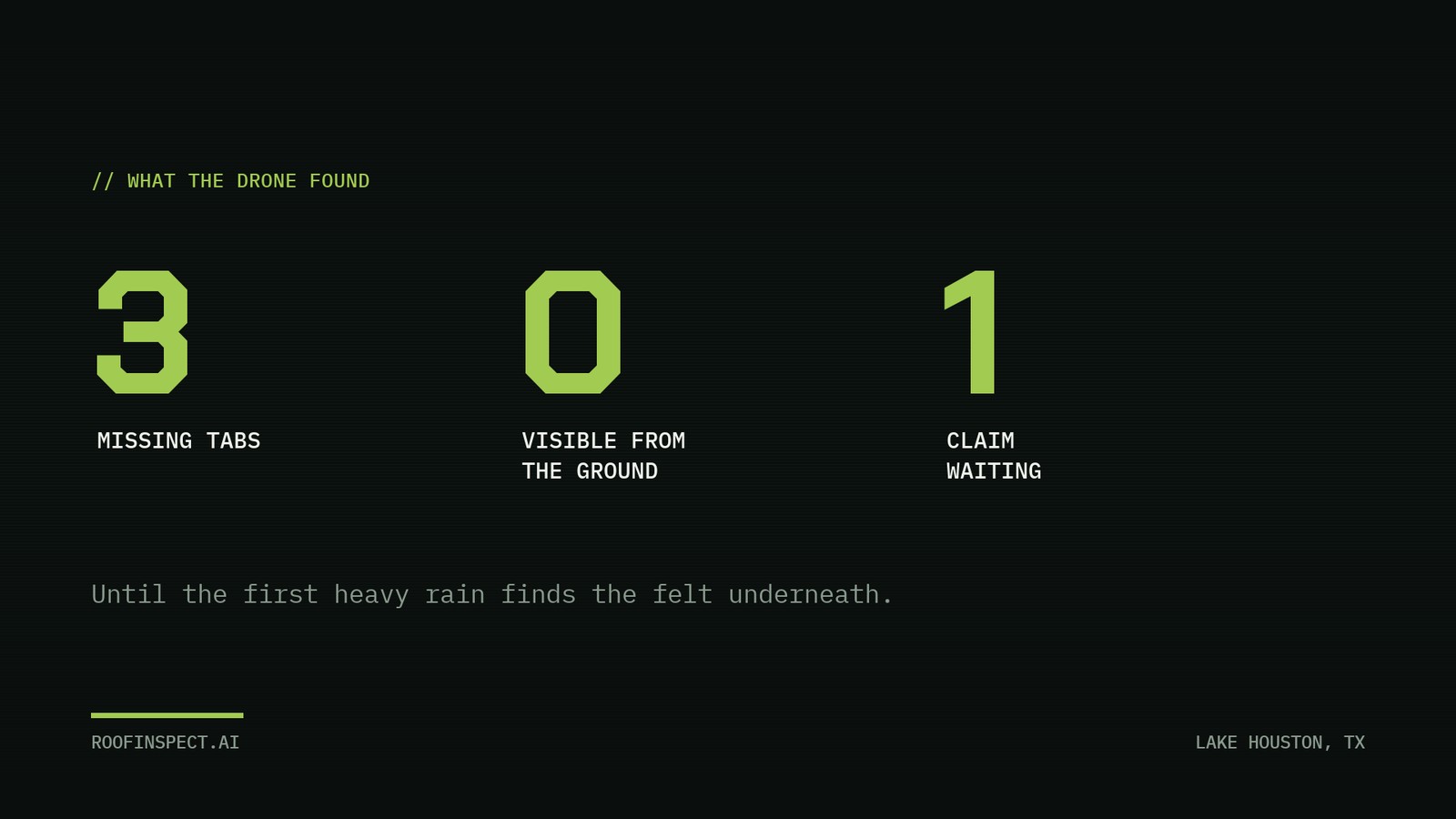 Three missing tabs. Zero visible from the ground. One claim waiting.
A drone flying a straight-down pattern above the entire roof images every course on every slope. The AI model reads those images and then they are reviewed manually the way an adjuster reads them, looking for the small dark rectangle where a tab should be, the crease line where one is about to go, and the granule loss that says a shingle has been flexing in the wind.
On this roof it found three. It took about ten minutes of flight time and put green boxes around each one with a confidence score, so the report is not an opinion. It is a picture with a location.
Why underwriters are asking for it
If you have tried to buy or renew a homeowner's policy in the Houston area lately, you already know coverage is harder to get than it used to be. Insurers are looking at roofs more closely before they bind, and a growing number are asking for an inspection report as part of underwriting.
A pre-underwriting inspection puts you ahead of that question. You know the condition of the roof before the insurer does, you know what needs fixing, and you have an opportunity to fix what needs fixing and you show up with documentation instead of waiting to be told you must fix before coverage will be provided.
An annual inspection does the same thing on a schedule. It costs less than the $80.00 and it catches the three-tab problem while it is still a three-tab problem, and it gives you a dated record of the roof's condition that matters the day you need to prove a storm did the damage and not neglect.
Know what's up there before your insurance company does
Wind damage is not always dramatic. Most of the time it is three tabs on the back slope that nobody will ever see from the ground. The drone will.